More of your customers now ask an AI assistant instead of typing a search: “Who is a good roofer in Longview?” or “Best Mexican restaurant in Kelso?” ChatGPT, Gemini, Perplexity and Google’s own AI answers reply with a few names, and those businesses get the call.
You cannot buy your way into those answers. But you can make your business easy for an assistant to understand, trust and recommend. Here is how to check what AI says about you today, and eight steps that help a local business get mentioned.
Check What AI Says About You Now
Ask the questions your customers ask, the way they ask them. Use ChatGPT, Gemini, Perplexity and a Google search that shows an AI answer, ideally in a private window.
- “Who is the best [your service] in [your town]?”
- “Recommend a [your service] near [a nearby town].”
- “What are [your business name]’s hours and phone number?”
- “Is [your business name] good?”
Write down whether you are mentioned, who is mentioned instead, and anything the assistant gets wrong: an old phone number, a service you stopped offering, the wrong town. Those wrong facts are where to start.
How Assistants Choose Who to Mention
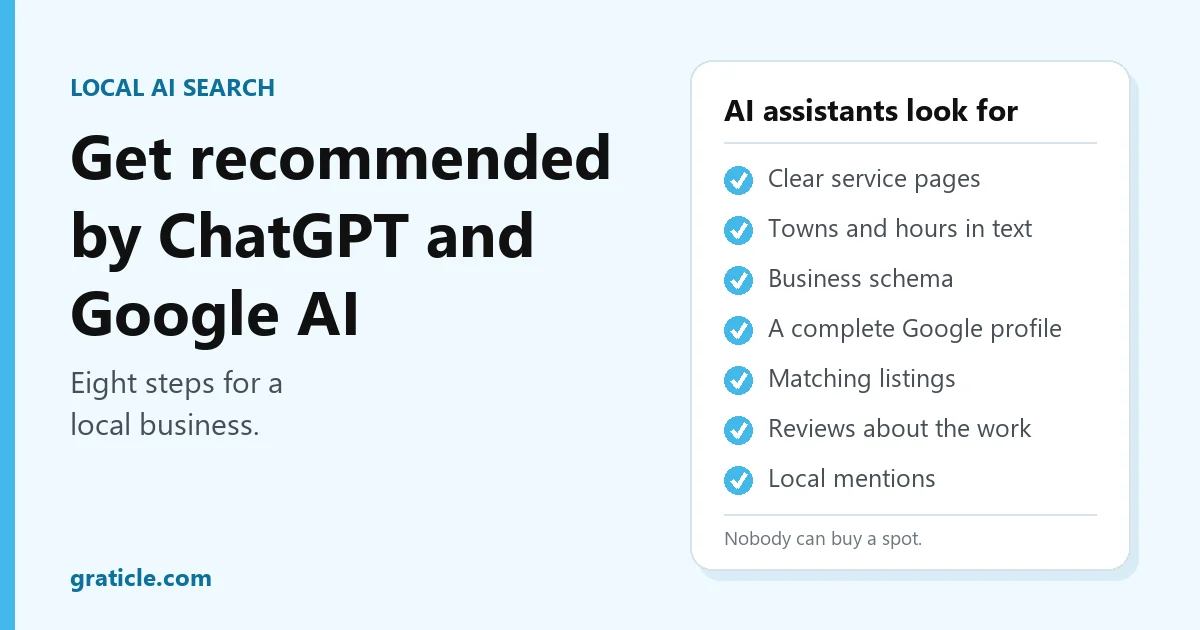
Most assistants look things up on the web when they answer a local question. They lean on the same sources search engines trust: your website, your Google Business Profile, Bing Places, Apple Business Connect, Yelp, local directories, reviews and local news. Three things matter most.
- Clear facts. What you do, where you do it and how to reach you, stated plainly on your own website.
- Agreement across sources. When your website, Google, Bing and directories all say the same thing, an assistant can repeat it with confidence. When they disagree, it hesitates or picks someone else.
- Proof from real customers. Reviews that describe the actual work and the town, not only stars.
Eight Steps to Get Recommended
1. Give each service its own page
A page called “Roof Replacement in Longview, WA” that explains the work, the area and how to ask for an estimate is easy for an assistant to match to a question. A single list of services on the homepage is not.
2. Say where you work, in plain text
List your towns and your hours as words on the page, not only inside a map or an image. Software reads text far more reliably.
3. Add business details machines can read
Business schema is a short block of code that states your name, address, phone, hours and services in a format search engines and assistants understand. Our free website score checks whether your homepage has it.
4. Complete your Google Business Profile
Categories, services, service area, hours, photos and a clear description. Google’s AI answers draw heavily on it. See our Google Business Profile service or how to show up on Google Maps without a storefront.
5. Claim Bing, Apple and the main directories
Claim Bing Places and Apple Business Connect, then check Yelp, the BBB, Facebook and your chamber of commerce. Fix any old address, phone number or website.
6. Ask for reviews that describe the work
When you ask for a review, ask the customer to mention what you did and where. “They replaced our roof in Castle Rock in two days” tells an assistant far more than “Great service.” Never write reviews for customers or pay for them. Our free review link maker makes asking easy.
7. Answer the questions customers ask
Add a short questions section to each service page: how long the job takes, whether you serve their town, what affects the price, whether you are licensed. Assistants look for direct answers.
8. Get mentioned in local places
Chamber listings, sponsorships, local news, partner businesses and community groups that link to you are the kind of independent mentions assistants trust.
What to Avoid
- Copy-and-paste town pages. Dozens of pages that only swap the town name help nobody and can hurt you. Write real pages for the towns you actually serve.
- Fake or paid reviews. They break Google’s rules and can get your profile suspended.
- Anyone who guarantees a ChatGPT ranking. Nobody controls what an assistant says. Good work makes you a likely answer, not a guaranteed one.
How Long It Takes
Fixing wrong facts can show up within weeks, as assistants and search engines refresh what they know. Reviews and local mentions build over months. Check the same questions every month or two and keep notes, so you can see what changed.
For the full picture, read our guide to generative engine optimization.
Questions People Ask
Can I pay to be recommended by ChatGPT?
No. ChatGPT, Gemini and Google do not sell placement in their AI answers. You get mentioned by being easy to understand and trusted across the web: clear pages, a complete Google Business Profile, consistent listings and real reviews.
How do I find out what ChatGPT says about my business?
Ask it the questions your customers ask, such as who the best roofer in your town is, and ask about your business by name. Try Gemini, Perplexity and Google too, and write down anything they get wrong.
Is this different from SEO?
It overlaps a lot. Clear service pages, business schema, a complete Google profile and good reviews help both. AI search adds more weight to agreement across sources and to reviews that describe the work.