Last year we made our way too early 2027 web design predictions. Some are already showing up on the sites we build. So we are doing it again, one year further out.
A fair warning: these are predictions, not promises. Nobody knows exactly what the web looks like in 2028. But the direction is already visible in how people search, how they decide who to trust and how much of the web is now written and read by software.
The Short Version
By 2028, more of your website’s visitors will not be people at all. The people who do arrive will come later in their decision, with less patience and more suspicion. The businesses that win will be the ones that are easy for software to understand and easy for humans to trust.
Prediction 1
Your First Visitor Is an AI Assistant
Today a person searches, opens three tabs and compares. In 2028 a growing share of people will ask an assistant to do it for them: find a plumber who can come tomorrow, compare three landscapers or book a table for six. The assistant reads your website before any human does.
That changes what a good website is. An assistant does not care about your hero animation. It wants facts it can trust: what you do, where you do it, your hours, how to book or request a quote and what other customers say. If those facts are buried in images, scattered across pages or out of date, the assistant moves on to a competitor whose site is clear.
What it means for you: plain text for your services, service area and hours, structured data that labels them, and a quote or booking path that works without a phone call. Being easy for software to read becomes as important as looking good to people.
Prediction 2
Fewer Clicks, Better Clicks
Search results already answer simple questions on the results page. By 2028 the click from a quick question will mostly be gone. Nobody will visit your site to learn your hours or whether you serve their town.
The clicks that are left will be worth more. Someone who reaches your website in 2028 has usually already narrowed the list to two or three businesses and wants one thing: a reason to pick you. Traffic numbers will look worse while leads stay steady or grow, and businesses that judge their website by visits alone will make bad decisions.
What it means for you: measure calls, form requests and booked jobs, not page views. Design every page for a visitor who is almost ready to decide, with proof and a clear next step close to the top. We set this up for clients with simple lead tracking and a lead value calculator that shows what a lead is worth to you.
Prediction 3
Proof of Origin Becomes a Design Element
In our 2027 predictions we said radical proof would beat polish. In 2028 we think it goes one step further. When any photo, review or testimonial can be generated in seconds, people will start asking where things came from.
Expect to see more labels that show a photo is real and unedited, reviews tied to verified customers, team pages with real names and faces, and dated project stories. Some of this will come from new standards for content credentials that record where an image came from. Some will just be good design choices that make honesty easy to see.
What it means for you: start building a library of your own photos and videos now: your team, your work, your shop, your trucks. Collect reviews on Google, where they are hard to fake. The businesses with years of real material will have an advantage nobody can copy overnight.
Prediction 4
The Thin Page Disappears
For years, some websites grew by adding pages: one for every town, every service and every keyword, each a slight rewording of the last. With software now able to write those pages by the thousand, search engines and assistants are getting better at ignoring them.
By 2028 we expect a page to need a real reason to exist. A town page should show work you did in that town, people you served and what is different about it. A service page should answer the questions customers really ask, with real examples. Fewer pages, each with substance, will beat a large site full of near copies.
What it means for you: look at every page on your site and ask whether a customer would miss it. Improve the ones that matter, combine the ones that repeat each other and redirect the rest.
Prediction 5
Accessibility Stops Being Optional
Accessibility means a website works for people who use screen readers, keyboards, captions or larger text. It has been treated as a nice extra for too long. That is changing. The European Accessibility Act began applying to many businesses selling to European customers in 2025, and a 2024 federal rule set accessibility deadlines for state and local government websites in the United States. Website accessibility lawsuits against private businesses continue every year.
We expect 2028 to be the year accessibility becomes a basic expectation, the way mobile-friendly design did a decade ago. Customers, insurers and larger clients will ask about it. And the same work that makes a site accessible, such as clear headings, real text instead of text in images, good color contrast and labeled buttons, also makes it easier for AI assistants to read.
What it means for you: fix the basics now: contrast, alt text on images, headings in order, forms with labels and video captions. It is far cheaper to build it in than to retrofit it under pressure.
Prediction 6
Local Search Goes Camera First
More people are searching by pointing their phone at something: a storefront, a broken part, a menu or a plant in their yard. By 2028 we expect camera and voice searches to be a normal way to find local businesses, especially on the go.
A camera search for a storefront leans on your Google Business Profile, your photos, your signage and your reviews more than on your homepage. A voice search like “who can fix a garage door near me today” leans on clear answers about service area, hours and availability.
What it means for you: keep your Google Business Profile complete and current, with fresh photos of the outside of your business, your vehicles and your work. Make sure your signage, your website and your profile all use the same name.
Prediction 7
The Phone Call Makes a Comeback
Here is our contrarian one. As more of the web is answered, written and booked by software, a real person becomes a selling point again. When every company has a chatbot, the one where a person answers the phone stands out.
We think the best small business websites of 2028 will be very good at automation in the background and very human in the foreground: real names, real faces, a phone number that rings a real person and fast, personal replies to every request.
What it means for you: put your phone number where people can tap it, answer it, and say on your website that a real person will. It is the one feature your largest competitors may never copy.
How to Get Ready in 2027
- Make your facts easy to find. Services, service area, hours and how to reach you in plain text on your site and your Google Business Profile.
- Measure leads, not visits. Track calls and form requests so a drop in traffic does not scare you into the wrong fix.
- Collect real proof. Your own photos, dated project stories and a steady flow of Google reviews.
- Prune and deepen. Fewer pages, each one worth reading.
- Fix accessibility basics. Contrast, alt text, headings, labels and captions.
- Answer the phone. And say so.
Our 2027 website checklist turns most of this into a 30-minute review, and our free website score checks several items for you.
The Graticle Philosophy
Every prediction here points the same way. The technology behind websites keeps getting more complicated, and what customers want keeps getting simpler: clear facts, real proof and a real person when they need one.
We do not chase every new tool. We build websites that are easy for people and software to understand, then keep them current so our clients do not have to think about it.
If you want your website ready for 2028, we should talk.
Questions People Ask
What are the biggest web design trends for 2028?
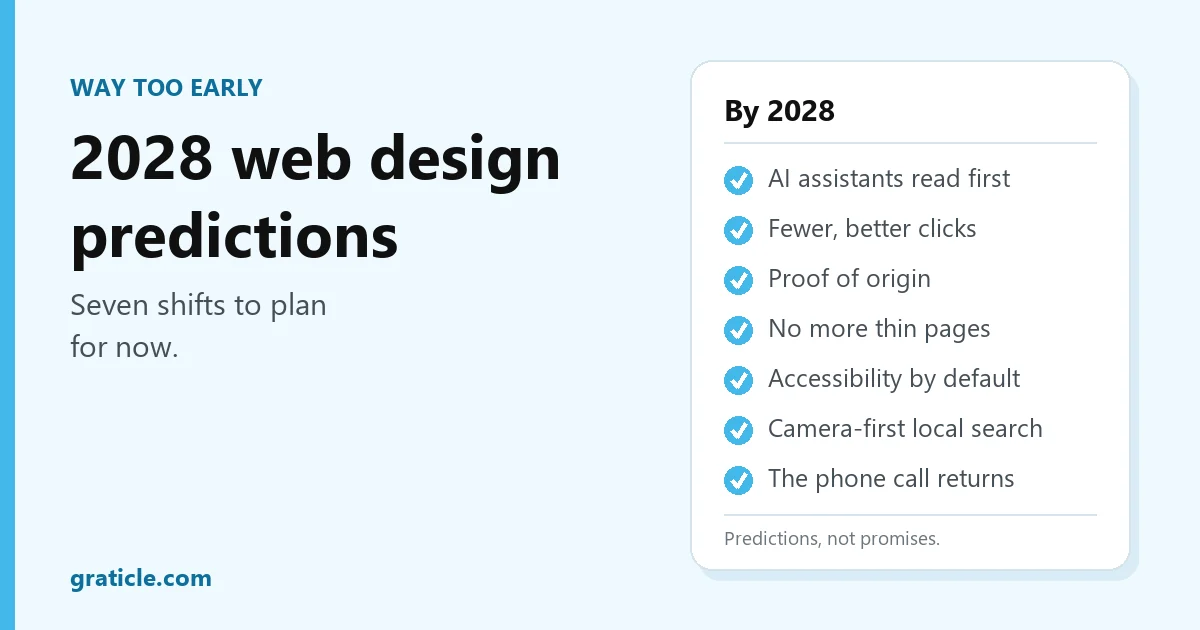
We expect AI assistants to read websites on behalf of customers, fewer but more valuable clicks from search, visible proof that photos and reviews are real, fewer and deeper pages, accessibility as a basic expectation, camera and voice local search, and a comeback for the real person on the phone.
Will AI replace small business websites by 2028?
No. AI assistants need somewhere to get trustworthy facts about your business, and your website and Google Business Profile are the main sources. What changes is that the site has to be clear for software as well as for people.
What should I do to my website now to prepare for 2028?
Put your services, service area and hours in plain text, track calls and form requests, collect real photos and Google reviews, remove thin or repeated pages and fix accessibility basics such as contrast, alt text and form labels.